
Immunopeptidomics

Immunopeptidomics services

At OHMX.bio, we offer advanced immunopeptidomics services designed to characterize and quantify peptides presented by Major Histocompatibility Complexes (MHCs). This powerful approach provides valuable insights into immune-related processes and aids in the discovery of novel biomarkers and therapeutic targets.

Why immunopeptidomics?

Unlike standard proteomics, which focuses on identifying and quantifying all proteins within a sample, immunopeptidomics specifically examines peptides presented by MHC molecules. These peptides represent the “visible” portion of the immune response, providing direct insights into antigen presentation and immune recognition. This makes immunopeptidomics particularly valuable for cancer immunotherapy, infectious disease research, and autoimmune disease studies.

Our immunopeptidomics workflow

1. Sample Preparation

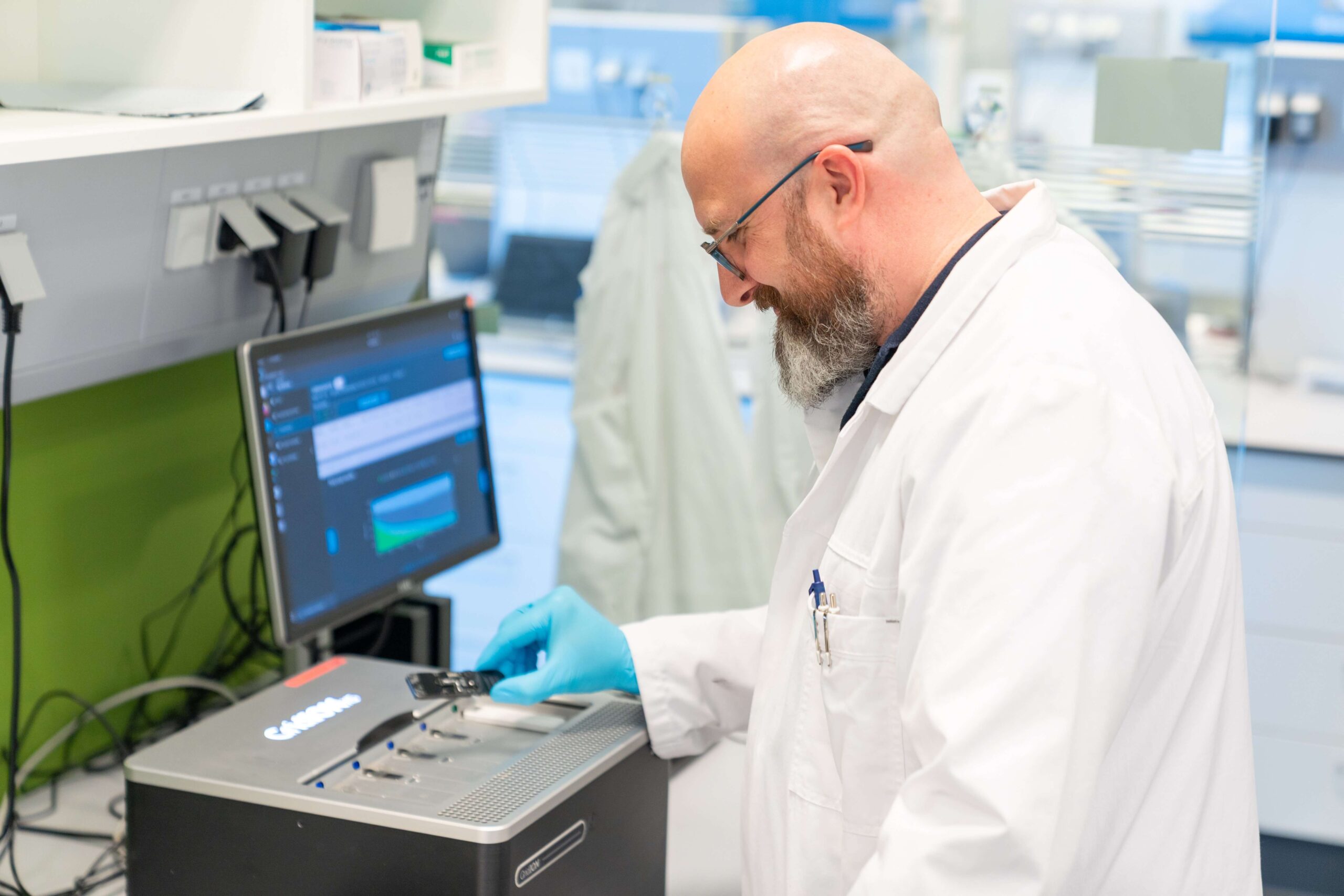
Biological samples are processed to isolate MHC-bound peptides through immunoaffinity purification techniques. Typical samples are cell lines, tissue samples and PBMC's or isolated immune cells

2. Mass Spectrometry Analysis

The purified peptides are analyzed using high-resolution mass spectrometry, enabling precise identification and quantification of the presented peptide repertoire.

3. Data Processing & Interpretation

Collected data is processed using state-of-the-art bioinformatics tools to characterize peptide sequences, predict antigenicity, and generate actionable insights. Typical output includes quantification and identity of peptides, peptide length distribution and (implied) motif analysis

OHMX.bio_Innovative omics solutions
OHMX.bio

Main applications for immunopeptidomics

The primary utility of immunopeptidomics lies in its ability to directly identify the specific peptide antigens that trigger T-cell responses. This has profound implications across several key research domains:

Oncology and Immuno-Oncology

Immunopeptidomics enables the discovery of tumor-associated antigens (TAAs) and patient-specific neoantigens arising from tumor mutations. These epitopes are prime targets for the development of personalized cancer vaccines, adoptive T-cell therapies (e.g., CAR-T, TCR-T), and immune checkpoint inhibitor biomarkers.

Infectious Disease and Vaccinology

Immunopeptidomics facilitates the rational design of vaccines by identifying the immunodominant epitopes derived from viral or bacterial pathogens that elicit protective T-cell immunity.

Autoimmunity and Transplantation

Immunopeptidomics allows for the characterization of the autoantigen repertoire responsible for pathogenic T-cell activation in autoimmune diseases. Similarly, it can identify alloantigens relevant to graft-versus-host disease in transplantation contexts.

Our immunopeptidomics services are tailored to meet the specific needs of your research, providing high sensitivity and reproducibility throughout the process. Contact us to learn more about how OHMX.bio can support your immunopeptidomics projects.

Let’s get in touch!

Are you curious about how we can work on your -omics challenges together? Fill out the form below!
Our experts will reply within 2 working days to freely discuss your omics project.

Frequently askes questions about our immunopeptidomics service solutions

OHMX.bio provides a broad portfolio of sequencing solutions, RNA sequencing, ribosomal profiling, whole-genome sequencing (WGS), whole-exome sequencing (WES), epigenetic sequencing, long-read sequencing, single-cell sequencing, and custom sequencing strategies. These services are supported by integrated bioinformatics analysis and tailored workflows to match specific research or clinical objectives. Projects can range from exploratory discovery studies to regulated diagnostic applications, ensuring flexibility and scientific rigor across use cases.
The workflow includes three main steps. First, MHC-bound peptides are isolated from biological samples using immunoaffinity purification. Second, purified peptides are analyzed using high-resolution LC-MS/MS. Third, advanced bioinformatics pipelines identify peptide sequences, determine their protein of origin, quantify abundance, and predict MHC binding motifs.
In oncology, immunopeptidomics identifies tumor-associated antigens and neoantigens for personalized vaccines and adoptive T-cell therapies. In infectious disease research, it supports rational vaccine design by identifying immunodominant pathogen-derived epitopes. In autoimmunity and transplantation research, it characterizes autoantigens and alloantigens driving pathological immune responses.
Final deliverables include a curated list of identified peptide sequences with confidence scores, protein-of-origin information, peptide length distributions, motif analyses, and quantitative metrics such as spectral intensity. These datasets can guide therapeutic target selection and biomarker discovery. Custom output can be delivered on request.
Yes. Integrating immunopeptidomics with whole-genome sequencing, RNA sequencing, ribosome profiling, and epigenomics significantly expands antigen discovery. This multi-omics approach enables identification of cryptic or “dark” antigens and provides a more comprehensive understanding of immune targets.

Our publications using immunopeptidomics services

  1.