Dark antigens: Expanding the horizons of immunopeptidomics and multi-omics discovery

Introduction to dark antigens
The antigenic universe accessible to T cells extends far beyond the conventional proteome. Dark antigens, also referred to as cryptic, hidden, or noncanonical antigens, are by-products of genomic and translational events outside conventional annotated protein-coding space and therefore occult to traditional neoantigen pipelines. Because they are outside conventional discovery pathways, these cryptic antigens represent a vast and largely untapped reservoir of immunogenic targets. Data indicates that most cancer-restricted epitopes are found in the “dark” antigen space, offering new therapeutic opportunities. Mass spectrometry analysis reveals cryptic peptides make up the majority of the immunopeptidome, with dominant immunogenic ones in certain tumors. The cryptic immunopeptidome is increasingly seen as a major contributor to tumor specificity, with many cryptic MAPs (MHC-associated peptides) arising from splicing abnormalities, noncoding RNAs, untranslated regions, and epigenetically deregulated loci1-7. OHMX.bio aims to illuminate this frontier by integrating immunopeptidomics with genomics, transcriptomics, epigenomics, and ribosome profiling, thereby enabling systematic discovery of dark antigens and accelerating their translation into immunotherapy.

What are dark antigens?

Dark antigens represent unconventional translation products that are presented on major histocompatibility complex class I (MHC-I) molecules. These peptides arise when eukaryotic ribosomes translate genomic regions beyond annotated open reading frames (ORFs), generating novel antigens not captured by standard proteomic analyses. Non-canonical MHC-associated peptides (ncMAPs) are produced from aberrantly translated small ORFs (sORFs) in non-protein-coding regions like untranslated regions, long non-coding RNAs, and pseudogenes. These dark antigens extend beyond conventional proteomics, generating peptides from introns, reading frames, pseudogenes, noncoding RNA transcripts, and non-AUG initiation codons. Most tumour-specific MHC-associated peptides in this dark genomic compartment are derived from genomic loci with limited expression in normal tissues, causing strong central tolerance and strong Cytotoxic T Lymphocyte (CTL) responses in most cancers.

These cryptic proteins are encoded by short ORFs, which frequently start translation from non-AUG codons that are nearly identical.  The biological relevance of cryptic proteins is demonstrated by the fact that they are more frequently detected in the immunopeptidome than their canonical counterparts.  Strong options for the development of universal or semi-universal cancer vaccines are presented by the non-canonical peptides that are shared by a variety of malignancies. Experimental studies reveal tumor immunopeptidomes, including pancreatic cancer, contain dark or cryptic peptides that induce direct tumor cell killing through CTL activation. Vaccination with these peptides has shown robust anti-tumour effects in preclinical models, revealing numerous nonmutated peptides from previously non-coding genomic regions. These dark antigens exhibit tumour-specific expression and recurrent detection, making them promising candidates for next-generation cancer immunotherapy1-4.

The role of multi-omics in discovering dark antigens

Discovering dark antigens is inherently more complex than conventional neoantigens, because their sources lie outside standard annotation. Mass‐spectrometry immunopeptidomics alone can miss these signals but combining it with transcriptomics and genomics dramatically expands discovery. Layered omics has revealed peptides from cryptic open reading frames in untranslated regions, introns, noncoding RNAs and alternative splice isoforms. Dark peptides, often elusive in database searches due to noncanonical sources like alternative reading frames or untranslated regions, are identified when sample-specific transcriptomes are translated and combined with genomic data variant calls. This immunopeptidogenomic strategy has demonstrated the ability to recover the vast majority of known HLA ligands while uncovering hundreds of previously undetected peptides. A hidden layer of immunological targets beyond the standard proteome can be revealed by researchers mapping the whole landscape of presenting antigens by combining immunopeptidomic data with RNA-Seq and DNA-Seq. This holistic approach is critical for developing precision immunotherapy and understanding tumor immune evasion mechanisms.

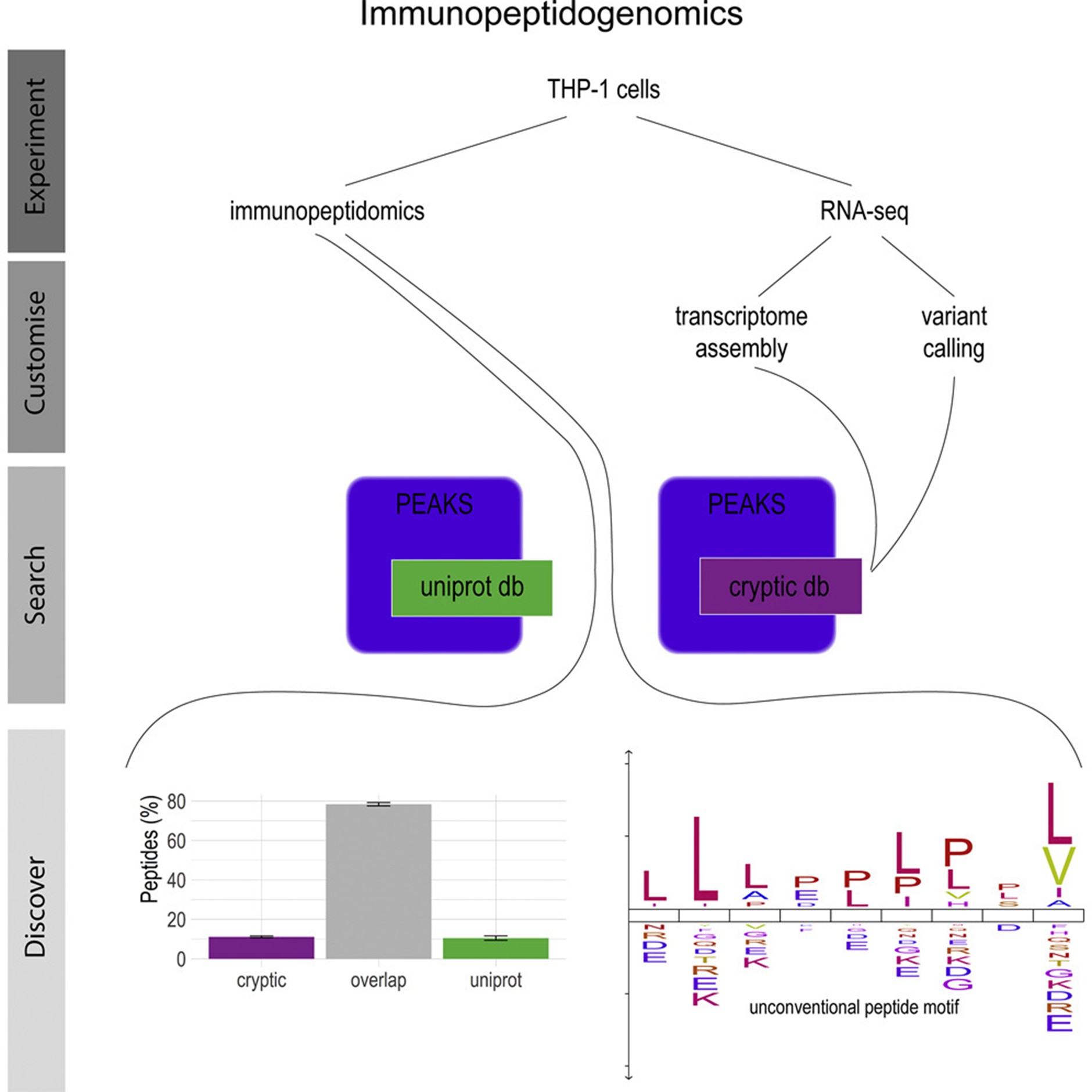
Bioinformatic pipelines are key to this multi-omics strategy. For example, a workflow of “immunopeptidogenomics” has been generated that employs RNA-Seq to construct a user-specific protein database by collapsing transcripts, reading them in three frames, and adding sample-specific mutations via variant calling. The resulting custom FASTA is then used to search the HLA‐peptide mass spectra. This pipeline relies on tools like STAR and GATK for alignment and mutation calling, and on in-house scripts to three-frame-translate transcripts and merge them into “cryptic” protein entries. In acute myeloid leukemia and similar contexts, advanced proteogenomic approaches have successfully recapitulated most standard peptides while identifying thousands of novel epitopes. End-to-end frameworks now integrate mass spectrometry-based immunopeptidomics with tumor DNA and RNA sequencing to predict and rank tumor-specific antigens, including canonical neoantigens, viral peptides, and noncanonical tumor-specific antigens, aiding vaccine development. By combining genomics, transcriptomics, and proteomics, these pipelines can detect peptides that would otherwise remain hidden.
Immunopeptidomics
Immunopeptidogenomics. Source: Katherine E. Scull, Kirti Pandey, Sri H. Ramarathinam, Anthony W. Purcell, Immunopeptidogenomics: Harnessing RNA-Seq to Illuminate the Dark Immunopeptidome, Molecular & Cellular Proteomics, Volume 20, 2021, 100143, ISSN 1535-9476, https://doi.org/10.1016/j.mcpro.2021.100143.
Researchers are using specific workflows to identify new HLA-I peptides originating from circular RNAs in various cancer types. These peptides screen for back-splice junctions, are stored in custom databases, and undergo rigorous mass spectrometry searches. The methods also involve translating entire transcriptomes, including the noncoding RNAs, and sorting the resulting mass spectrometry data against universal protein databases to eliminate known sequences. Integrating immunopeptidomics with genomics, transcriptomics, epigenomics, and translatomics is increasingly crucial to the identification of antigenic peptides which are typically ignored by conventional proteomic pipelines. This multi-omic approach enhances the resolution of the antigen landscape, helping to reveal new targets for cancer immunotherapy and advance personalized medicine approaches7-9.

Applications in cancer and immunotherapy

Peptides from cancer cells outside of the canonical set are a new area of potential for immunotherapy. An ever-growing body of data suggests that antigen-presenting cells, including dendritic cells, present these “dark” peptides on MHC molecules and thus activate tumor-reactive T cells; along with this, prototype vaccines based on such peptides have been developed. In a striking proof-of-concept, T cells that were programmed to target cryptic peptides, which are translated from genomic regions that are classically regarded as noncoding, were found to slow tumor growth in pancreatic organoid systems. Analogously, mouse immunization with combinatorial pools of combinatorial tumor-restricted cryptic peptides induced intense CD8⁺ T-cell responses and caused significant tumor regression in preclinical models. These findings confirm that non-mutated dark antigens are indeed true immunogens: they are specifically expressed on tumor cells and, when presented to the immune system, elicit robust responses.

Cryptocytic peptides are guiding new diagnostics and treatments beyond vaccinations. Noncanonical peptides have been included in CAR-T designs to increase tumour selectivity and broaden TIL therapy. Methodical mapping of patient HLA ligand repertoires is identifying shared cryptic epitopes, suggesting potential diagnostic biomarkers or targets. High-resolution identification is being defined using deep sequencing, proteogenomic processes, and ribosome profiling (Ribo-seq). Coupled with mass spectrometry and de novo peptide discovery, comprehensive immunopeptidome atlases reveal thousands of noncanonical MHC class I–associated peptides (ncMAPs), derived from untranslated regions, long noncoding RNAs, upstream open reading frames, pseudogenes, introns, and alternative reading frames. Many of these peptides recur across tumor types and exhibit favorable attributes, high predicted MHC-binding affinity, optimal T-cell contact residues, and negligible expression in normal tissues. Modern computational frameworks enable weighted prioritization of candidate antigens, balancing tumor specificity, immunogenic potential, and safety constraints, demonstrating substantial tumor suppression in lung cancer preclinical models. In acute myeloid leukemia models, integrating both canonical and noncanonical antigen repertoires expands the therapeutic target space, with several noncanonical peptides ranking among the most predictive of immune infiltration and treatment response. Recent advancements have thus, reveal an expanding repertoire of epitopes, many of which are being translated into immunotherapeutic targets, providing a rich reservoir of antigens for cancer vaccines, engineered T cells, immune monitoring, and diagnostic use5,6,10.

OHMX.bio’s role in dark antigen discovery

At OHMX.bio, our vision is to provide a state-of-the-art multi-omics-driven dark antigen discovery engine. Starting from tumor and matched normal samples, we can perform deep genomic profiling (WGS/WES) and transcriptomics (RNA-seq with splice and circular RNA resolution). We add ribosome profiling to capture translational evidence and epigenomics (ATAC-seq, methylation) to define regulatory context. We then construct a bespoke expanded reference library combining canonical and cryptic ORFs. Using advanced immunopeptidomics, we isolate MHC-bound peptides and search via motif-guided, inclusion-list–augmented pipelines (e.g. inspired by NeoDiscMS and IntroSpect). We apply machine learning and filtering (expression, translation confidence, binding affinity, immunogenicity predictors) to rank candidates. Finally, OHMX.bio validates top peptides via synthetic peptide binding assays, cellular T cell activation assays, and TCR screening. By closing the loop from DNA to peptide to immunological function, OHMX.bio positions itself as a pioneering partner in translating dark antigens into cancer vaccine and T cell therapy leads.

Conclusion

Dark antigens represent a transformative expansion of the antigenic universe, transforming occult genomic and translational events into actionable immunotherapeutic targets. By combining immunopeptidomics with genomics, transcriptomics, epigenomics, and ribosome profiling, it is possible to systematically identify cryptic epitopes that traditional methods miss. Dark antigens hold significant potential to improve vaccine coverage, refine TCR-based therapies, and uncover novel biomarkers, especially in cancers with low mutational burden. With its integrated multi-omics discovery platform and strong translational validation capabilities, OHMX.bio is well positioned to lead the next wave of immunotherapy innovation by illuminating the dark antigen frontier.

Frequently asked questions about dark antigens

Dark antigens are noncanonical peptides that originate from genomic regions outside traditional protein-coding sequences. They may arise from untranslated regions, introns, alternative reading frames, pseudogenes, or long non-coding RNAs. Because conventional proteomics pipelines focus on annotated proteins, these peptides often remain undetected. However, many dark antigens are presented on MHC molecules and can trigger immune responses, making them promising targets in cancer immunotherapy.
Mass spectrometry alone may miss cryptic peptides. Therefore, dark antigen discovery requires integration of immunopeptidomics with genomics, transcriptomics, ribosome profiling, and epigenomics. By constructing sample-specific protein databases derived from RNA sequencing and variant calling, researchers can detect peptides that would otherwise remain invisible. This layered multi-omics strategy dramatically expands the antigen landscape and enables systematic discovery of novel immunogenic targets.
Dark antigens can serve as targets for personalized cancer vaccines, adoptive T-cell therapies, and engineered CAR-T or TCR therapies. Because these peptides often originate from regions with minimal expression in healthy tissue, they may bypass central immune tolerance and generate strong cytotoxic T-cell responses. Preclinical studies demonstrate that targeting cryptic peptides can reduce tumor growth and improve immune activation.
OHMX.bio combines deep genomic sequencing (WGS/WES), RNA sequencing, ribosome profiling, and epigenetic profiling with high-resolution immunopeptidomics. Expanded protein reference libraries include both canonical and cryptic open reading frames. Machine learning and motif-guided search pipelines rank candidate peptides, followed by functional validation using binding assays and T-cell activation studies. This end-to-end workflow enables translation of dark antigens into therapeutic strategies.
Yes. While particularly impactful in cancer immunotherapy, dark antigens may also be relevant in infectious diseases and autoimmune research. Expanding the detectable antigen repertoire improves understanding of immune recognition and may uncover novel diagnostic or therapeutic targets in multiple disease areas.

References

[1] Starck, S. R., & Shastri, N. (2016). Nowhere to hide: unconventional translation yields cryptic peptides for immune surveillance. Immunological reviews272(1), 8-16.

[2] Chong, C., Coukos, G., & Bassani-Sternberg, M. (2022). Identification of tumor antigens with immunopeptidomics. Nature biotechnology40(2), 175-188.

[3] Kina, E., Larouche, J. D., Thibault, P., & Perreault, C. (2025). The cryptic immunopeptidome in health and disease. Trends in Genetics.

[4] Saffern, M., & Samstein, R. (2023). MHCing the tumour’s dark genome. Nature reviews. Immunology23(3), 140.

[5] Raja, R., Mangalaparthi, K. K., Madugundu, A. K., Jessen, E., Pathangey, L., Magtibay, P., … & Curtis, M. (2025). Immunogenic cryptic peptides dominate the antigenic landscape of ovarian cancer. Science Advances11(8), eads7405.

[6] Ruzzi, F., Riccardo, F., Conti, L., Tarone, L., Semprini, M. S., Bolli, E., … & Cavallo, F. (2025). Cancer vaccines: Target antigens, vaccine platforms and preclinical models. Molecular Aspects of Medicine101, 101324.

[7] Huber, F., Arnaud, M., Stevenson, B. J., Michaux, J., Benedetti, F., Thevenet, J., … & Bassani-Sternberg, M. (2024). A comprehensive proteogenomic pipeline for neoantigen discovery to advance personalized cancer immunotherapy. Nature biotechnology, 1-13.

[8] Ferreira, H. J., Stevenson, B. J., Pak, H., Yu, F., Almeida Oliveira, J., Huber, F., … & Bassani-Sternberg, M. (2024). Immunopeptidomics-based identification of naturally presented non-canonical circRNA-derived peptides. Nature communications15(1), 2357.

[9] Scull, K. E., Pandey, K., Ramarathinam, S. H., & Purcell, A. W. (2021). Immunopeptidogenomics: Harnessing RNA-seq to illuminate the dark immunopeptidome. Molecular & Cellular Proteomics20, 100143.

[10] Schaeffeler, E., Walz, J., & Schwab, M. (2025). Personalized cancer vaccination is emerging: lessons learnt from renal cancer and challenges for broader application. Signal Transduction and Targeted Therapy10(1), 107.

Search all posts

Popular news & events

Tags

Do you have questions about dark antigens?

Fill out the form below and our experts will get back to you as soon as possible!
Logo-OHMX.bio
Privacy Overview

This website uses cookies so that we can provide you with the best user experience possible. Cookie information is stored in your browser and performs functions such as recognising you when you return to our website and helping our team to understand which sections of the website you find most interesting and useful.

Cookie statement

Last updated:  19-09-2024

This cookie statement is drafted and managed by OHMX.bio NV,

hereafter referred to as “OHMX.bio”.

OHMX.bio has its headquarters at Proeftuinstraat 86, 9000 Gent, Belgium, registered with company number XXX.

For all questions and/or remarks, please contact us at the address mentioned above or at the e-mail address privacy@ohmx.bio.

USE OF COOKIES


OHMX.bio considers it important that you can view, listen to, read or experience our website content at any place and at any time via various media platforms. We want you to be able to use interactive features and provide services tailored to your needs. Therefore OHMX.BIO uses online techniques like cookies, scripts and similar technologies (hereafter referred to as ‘cookies’). These help us facilitate the use of the website and improve its functionality, by collecting (personal) data of our website visitors via their website usage.


In this cookie statement, OHMX.bio wishes to inform you what kind of cookies are used and why.

OHMX.bio can amend the cookie statement at any time. This can happen, for example, in the context of changes to its services or the applicable legislation. The amended statement will then be published on the OHMX.bio websites and will apply from the moment it is published.


If the use of certain cookies also involves the processing of “personal data”, the OHMX.bio Privacy Statement is also applicable.


WHAT ARE COOKIES?


A cookie is a small data file that is installed in the browser of your computer or mobile device by a website's server or application when you visit a website or use a (mobile) application.

The cookie file contains a unique code with which your browser can be recognized during the visit to the online service or during consecutive, repeated visits. They generally make the interaction between the visitor and the website or application easier and faster and help the visitor to navigate between the different parts of a website or application. They allow us to retain certain settings, such as your language choice or to optimize your user experience.


There are different types of cookies that can be distinguished according to their origin, function and lifespan. This is explained further in the next section.

TYPES OF COOKIES

How long are cookies stored?

Cookies can be stored on your computer or mobile device for different periods of time. Depending on the type, they (and the information they collect) are automatically deleted when you close your browser (these are the so-called “session cookies”), in other cases, these remain stored for a longer period of time and can also be used during a subsequent visit to this website (these are the so-called “permanent cookies”).

Consult the detailed information on OHMX.bio cookies (below) to know the retention periods.

Who places and manages cookies?

First-party cookies

First-party cookies are managed by OHMX.bio and are specific to the visited or used online service.

Third party cookies

Third party cookies are managed and placed by a third party. This happens during your visit or use of the website. These ensure that certain information is sent to third parties by your visit to the website.

Why cookies?

Necessary cookies

Necessary or essential cookies are necessary for the operation of the website. It is therefore advised not to disable these.

Functional cookies

These are cookies that ensure that the website functions properly. Examples of some functions performed:

- remembering your login details

- ensuring the security of your login details

- ensuring the uniformity of the layout of the website

Performance and analysis cookies

On the basis of these cookies, information is collected about the way visitors use our website. This is done with the intention to improve the content of our websites, to further adapt it to the wishes of the visitors and to increase the usability of our websites. Like for example google analytics.

Social media cookies

The website can implement so-called embedded elements of other third parties, such as YouTube, Twitter and Facebook. These are used to integrate social media into the website via plug-ins.

Other cookies

These are cookies that do not belong to one of the above categories. For example, cookies that can be used to make web analyzes themselves to optimize the website. In addition to the above-mentioned performance and analysis cookies, other web analysis cookies can be used. These will probably have to be disabled because identifiable personal data may be processed here. This is not the case with the mentioned performance analysis cookies.

OHMX.bio  uses different types of cookies.


Cookie Description Duration Type
cookielawinfo-checkbox-necessary This cookie is set by GDPR Cookie Consent plugin. The cookies is used to store the user consent for the cookies in the category "Necessary". 1 hour Necessary
__utma This cookie is set by Google Analytics and is used to distinguish users and sessions. The cookie is created when the JavaScript library executes and there are no existing __utma cookies. The cookie is updated every time data is sent to Google Analytics. 2 years Performance
__utmc The cookie is set by Google Analytics and is deleted when the user closes the browser. The cookie is not used by ga.js. The cookie is used to enable interoperability with urchin.js which is an older version of Google analytics and used in conjunction with the __utmb cookie to determine new sessions/visits. Performance
__utmz This cookie is set by Google analytics and is used to store the traffic source or campaign through which the visitor reached your site. 5 months Performance
__utmt The cookie is set by Google Analytics and is used to throttle request rate. 10 minutes Performance
__utmb The cookie is set by Google Analytics. The cookie is used to determine new sessions/visits. The cookie is created when the JavaScript library executes and there are no existing __utma cookies. The cookie is updated every time data is sent to Google Analytics. 30 minutes Performance


HOW CAN YOU TURN OFF COOKIES?


If you choose to disable cookies, you can do so for the browser you use:


If you use different devices to visit this website, make sure that your cookie preferences are set on the browser of every device.


Please note that disabling certain cookies may result in the malfunction of related features on the website e.g. certain graphics may not show the way they are meant to, or you may not be able to use certain services.

CHANGES TO THIS COOKIE STATEMENT

OHMX.BIO may amend this Cookie Statement in accordance with certain technical, legal or commercial requirements and developments. We will inform you accordingly, taking into account the importance of the changes that have been made. You may find the date on which this Cookie Statement was last modified at the top of this Cookie Statement.