Choosing the right biomarker strategy for early-stage clinical trials

Biomarkers carry the most value in early development when they are treated as decision tools rather than exploratory add-ons. A strong biomarker strategy for early clinical trials should define, before first patient dosing, which measures will inform dose selection, target engagement, patient selection, safety monitoring and early efficacy assessment. That plan also needs to separate evidence-generating assays from decision-enabling assays, since the evidentiary standard changes when a result influences escalation, expansion, cohort selection, or trial continuation. Regulatory expectations support this discipline. The ICH E16 guideline on genomic biomarkers related to drug response describes the context, structure, and format for qualification submissions involving clinical and nonclinical biomarkers in drug and biotechnology development, including translational medicine, pharmacokinetics, pharmacodynamics, efficacy, and safety1. For Phase I and Phase II studies, the practical goal is not to collect every plausible analyte. The goal is to build a biomarker framework that links biology, assay readiness, sample logistics, statistical interpretability, and governance into decisions that can be made while the trial is still active, rather than after database lock.

Start from decisions: what must the biomarker enable?

Biomarker selection should begin with the clinical and translational decisions that must be made during the study, not with the platform that appears most comprehensive. A broad multi-omics panel may generate useful biology, but it only becomes operationally valuable when each marker is tied to a decision point, such as escalation, cohort expansion, enrichment, stopping rules, or follow-on study design. This approach keeps the biomarker plan focused, reduces sample burden, and helps clinical operations align collection windows with protocol-critical readouts.

For early-stage trials, the strongest strategies usually combine a small number of decision-enabling biomarkers with a controlled layer of discovery profiling. Pharmacodynamic biomarkers may confirm pathway modulation after dosing, while predictive or prognostic markers can support patient selection before enrollment. Safety biomarkers require different timing, since changes may emerge after repeated exposure or around known risk windows. Translational profiling can then be used to interpret response patterns and identify signals for later validation.

A practical “decision matrix”

DecisionBiomarker typeTypical sampling
Dose selectionPharmacodynamic or target engagementPre-dose, early post-dose, and exposure-matched timepoints
Target engagementPathway, receptor occupancy, or downstream signalingPre-dose and mechanism-relevant post-dose windows
Patient selectionPredictive or prognosticPre-dose only, before randomization or cohort assignment
Safety monitoringSafety or organ-specific biomarkerPre-dose and at defined intervals during treatment
Early efficacy signalResponse, immune, molecular, or tissue-change markerBaseline and scheduled response-assessment timepoints
Resistance or escapeGenomic, transcriptomic, or proteomic changeBaseline, on-treatment, and progression where feasible

Biomarker types and roles (BEST-aligned language)

Consistent terminology matters because the same assay can support different decisions depending on its context of use. The BEST framework helps standardize biomarker language across clinical, translational, regulatory, and bioanalytical teams, which reduces ambiguity when assays move from exploratory profiling into protocol-defined decision-making.

Diagnostic biomarker: A diagnostic biomarker detects or confirms the presence of a disease, condition, or molecular subtype. In an early oncology trial, a tumor mutation assay may confirm eligibility for a study enrolling only patients with a defined genomic alteration.

Prognostic biomarker: A prognostic biomarker identifies the likelihood of a clinical outcome independent of treatment assignment. In a Phase I/II study, a baseline inflammatory signature may help interpret whether patients are at higher risk of rapid progression regardless of investigational therapy.

Predictive biomarker: A predictive biomarker identifies patients more likely to respond, or less likely to respond, to a specific therapy. The predictive vs prognostic biomarker distinction is important in early-stage development because enrichment decisions should be based on treatment-linked biology, not only on baseline disease risk.

Pharmacodynamic / response biomarker: A pharmacodynamic or response biomarker shows that a biological response has occurred after exposure to the investigational product. For example, a measurable reduction in pathway signaling after dosing can show whether the therapy is reaching its intended biological target and may help support dose selection before efficacy data are mature.

Safety biomarker: A safety biomarker flags early treatment-related risk, such as organ stress, immune activation, or toxicity linked to the drug’s mechanism, so monitoring can be adjusted during dose escalation. In an early immunology or oncology trial, serial cytokine, liver, renal, or cardiac markers may support risk monitoring around known mechanism-related safety windows.

Clear role assignment also helps determine assay readiness. A discovery marker may support hypothesis generation, while a marker used for enrollment, escalation, or stopping decisions requires stronger analytical control, documentation, and operational governance.

Patient selection and enrichment strategies

In clinical trial design, enrichment is the prospective selection of a study population with specific characteristics that maximize the likelihood of detecting a clear treatment response. Enrichment is most useful when it is planned as a structured development strategy, not as a late protocol adjustment. FDA’s enrichment guidance frames the concept around selecting patients through defined characteristics that may improve study efficiency, reduce heterogeneity, or increase the likelihood of detecting a meaningful treatment effect2. In early trials, this approach can sharpen biological interpretation, especially when response is expected to depend on target expression, pathway activation, genotype, immune state, or disease stage.

When predictive biomarkers are worth the upfront investment

Predictive biomarkers, biomarkers aimed at identifying patients that are more likely to respond, justify early investment when the biology is strong enough to support a treatment-linked hypothesis and when the expected effect size differs meaningfully between biomarker-defined groups. The trade-off is operational. Screening adds time, assay cost, sample handling complexity, and potential screen failure. These costs may be justified when the biomarker is common enough to support enrollment, rare but highly actionable, or essential to show proof of mechanism. In rare disease studies, a patient enrichment strategy may be central to feasibility rather than optional design refinement.

Practical requirements: prevalence, assay turnaround, cut-offs

A workable enrichment plan needs three practical elements before activation. First, prevalence estimates should be credible enough to support site selection, screening volume, and enrollment timelines. Second, assay turnaround must fit the clinical decision window, particularly when results determine eligibility or cohort assignment. Third, cut-offs should be defined provisionally, documented clearly, and revisited only through pre-specified rules. In early development, the cut-off does not need to be final, but it must be interpretable, feasible, and aligned with the decision it supports.

Fit-for-purpose assay validation: how much validation is enough in Phase I/II?

Fit-for-purpose biomarker validation means the level of analytical control should match the role of the biomarker in the trial. An exploratory cytokine, transcriptomic, or proteomic signal used for biological interpretation does not require the same validation package as an assay used for eligibility, dose escalation, cohort expansion, or a safety stopping rule. The practical question is not whether an assay is fully validated in the broadest sense. The question is whether the assay is reliable enough for the decision it is intended to support. FDA bioanalytical method validation principles provide a useful quality benchmark, even when an early biomarker assay is not yet positioned as a regulated pivotal assay.

Minimum validation package for exploratory biomarkers

Exploratory assays still need enough evidence to prevent misleading biology. A minimum package should usually address precision across runs, operators, and instruments where relevant, along with short-term and long-term analyte stability. Matrix effects should be assessed when plasma, serum, tissue lysate, CSF, or other complex matrices may interfere with detection. Sample handling robustness also matters, particularly when collection sites vary in staffing, processing equipment, or local laboratory experience. For multi-omics workflows, acceptable variability should be defined before analysis begins.

Pre-analytics: the hidden failure mode

Many early biomarker failures are not caused by the analytical platform. They begin before the sample reaches the instrument. Sampling timing must match the expected biology, especially for pharmacodynamic readouts that rise or decay quickly after dosing. Tube choice, anticoagulant, processing time, centrifugation conditions, freeze-thaw exposure, storage temperature, and shipment duration can all shift results. Batch effects can further distort interpretation when baseline and on-treatment samples are processed separately. A strong Phase I/II plan treats pre-analytics as part of assay performance, not as a logistics appendix.

Sampling strategy and operational reality

Phase_i_ii_sampling_timeline_Example_OHMX.bio
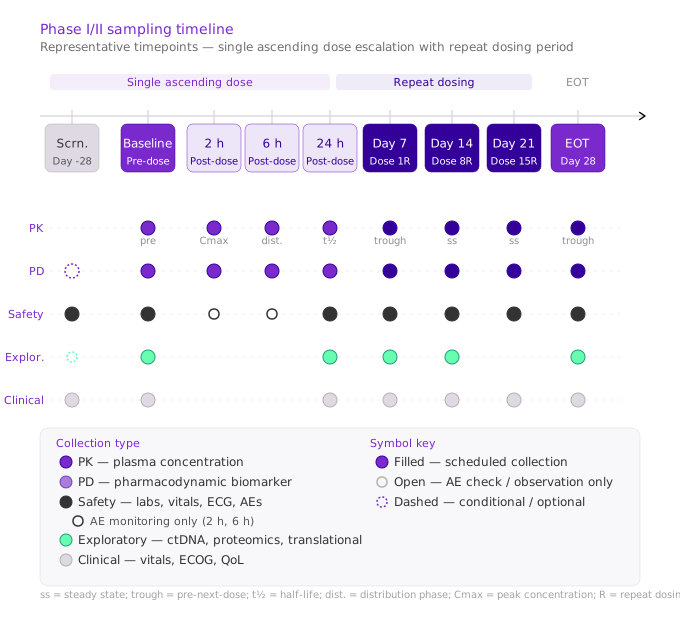
The timeline above shows a typical sampling schedule across key study milestones, from screening through end of treatment. Sampling points are aligned with clinical visits to minimise patient burden while capturing pharmacodynamic readouts at the most informative time points.

Note that this is an illustrative example. In practice, clinical trials can span several months to years, with sampling frequencies adjusted based on the therapeutic modality, study endpoints, and regulatory requirements.
A biomarker plan only works when the sampling model fits the protocol, the sites, and the biology. Timepoints should be defined early, with clear alignment to PK, expected target engagement, pharmacodynamic response, and safety risk windows. For clinical trial biomarkers that change quickly after dosing, broad collection windows can weaken interpretability. Slower molecular or immune readouts often do not need dense sampling. Well-timed baseline and follow-up samples can give clearer decision value than collecting more samples without a strong biological rationale.

Collection windows should reflect both site workflow and the biology being measured. If the window is too broad, the result may be easier to collect but harder to interpret. Sample volumes also need early review, especially in pediatrics, rare disease studies, oncology patients with intensive PK schedules, or protocols requiring multiple matrices. A technically attractive assay may become impractical if blood volume, biopsy burden, or processing steps are not feasible at participating sites.

Central lab logistics should be built into the strategy before activation. Required tube types, processing time, centrifugation conditions, storage temperature, shipment schedule, and chain-of-custody documentation need to be clear in the lab manual and site training materials. Batch planning also matters, since baseline and post-dose samples should be handled in a way that limits avoidable analytical variation. Operational feasibility is part of biomarker quality, not separate from it.

The easiest way to control cost is to define scope early and ask for the expertise of the provider. For some applications, deep sequencing might not add much information.

Data integration: linking biomarkers to endpoints

Biomarker data should be analyzed against the clinical questions the trial is designed to answer, not as a parallel scientific dataset. Early integration starts with mapping each readout to exposure, dose level, safety observations, response assessments, progression patterns, and relevant baseline characteristics. This structure makes the signal easier to interpret. It shows whether the change is linked to the drug’s target biology, baseline patient differences, exposure level, or variation introduced by the assay or sample handling.

In Phase I/II programs, integrated analysis can sharpen the next development question before a larger study is planned. A clear pharmacodynamic change may support dose selection, while a baseline molecular pattern may point to a better-defined subgroup. When biomarker changes are tracked over time and compared with response, toxicity, or progression, they can also help justify provisional cut-offs for the next protocol. These outputs are not a substitute for powered efficacy evidence, but they can inform sample size assumptions, stratification factors, assay prioritization, and endpoint strategy for the next protocol.

Frequently asked questions about biomarkers

A predictive biomarker identifies whether a patient is more or less likely to respond to a specific treatment. A prognostic biomarker indicates likely disease outcome regardless of treatment, which makes the distinction important for enrichment and trial interpretation.
In Phase I, the most useful biomarkers are usually the ones that answer immediate development questions: Is the drug reaching the target, is the pathway changing, is the dose biologically active, and are any safety signals emerging? Broader profiling can still add value, but only when it is tied to a specific translational question rather than added as extra data collection.
Enrichment works by narrowing the study population to patients who are more likely to give a readable clinical or biological signal. In early trials, that may mean selecting patients by genotype, target expression, pathway activity, disease stage, or treatment history, depending on the drug’s mechanism and the question the study needs to answer.
Fit-for-purpose validation means the assay evidence should match the biomarker’s intended role in the study. Exploratory biomarkers need basic reliability, while biomarkers used for enrollment, escalation, or stopping decisions need stronger analytical control.
Not every clinical trial biomarker requires FDA biomarker qualification. Qualification is generally relevant when a biomarker is intended for broader use across programs or drug development contexts, while many study-specific biomarkers can be justified within the protocol and statistical analysis plan.
Assay methods should be set before the first samples are collected, particularly when the result affects eligibility, dosing, or cohort assignment. Cut-offs can remain provisional in Phase I/II, but the reason for choosing them, the rules for changing them, and the analysis approach should be written down before results are reviewed.

Do you have questions about biomarkers

Fill out the form below and our experts will get back to you as soon as possible!

References

  1. European Medicines Agency. (n.d.). ICH E16 genomic biomarkers related to drug response: context, structure and format for qualification submissions. Assessed from https://www.ema.europa.eu/en/ich-e16-genomic-biomarkers-related-drug-response-context-structure-format-qualification-submissions-scientific-guideline

  2. U.S. Food and Drug Administration. (2019). Enrichment strategies for clinical trials to support approval of human drugs and biological products: Guidance for industry. Assessed from https://www.fda.gov/regulatory-information/search-fda-guidance-documents/enrichment-strategies-clinical-trials-support-approval-human-drugs-and-biological-products

Search all posts

Popular news & events

Tags

OHMX..bio logo
Privacy Overview

This website uses cookies so that we can provide you with the best user experience possible. Cookie information is stored in your browser and performs functions such as recognising you when you return to our website and helping our team to understand which sections of the website you find most interesting and useful.

Cookie statement

Last updated:  19-09-2024

This cookie statement is drafted and managed by OHMX.bio NV,

hereafter referred to as “OHMX.bio”.

OHMX.bio has its headquarters at Proeftuinstraat 86, 9000 Gent, Belgium, registered with company number XXX.

For all questions and/or remarks, please contact us at the address mentioned above or at the e-mail address privacy@ohmx.bio.

USE OF COOKIES


OHMX.bio considers it important that you can view, listen to, read or experience our website content at any place and at any time via various media platforms. We want you to be able to use interactive features and provide services tailored to your needs. Therefore OHMX.BIO uses online techniques like cookies, scripts and similar technologies (hereafter referred to as ‘cookies’). These help us facilitate the use of the website and improve its functionality, by collecting (personal) data of our website visitors via their website usage.


In this cookie statement, OHMX.bio wishes to inform you what kind of cookies are used and why.

OHMX.bio can amend the cookie statement at any time. This can happen, for example, in the context of changes to its services or the applicable legislation. The amended statement will then be published on the OHMX.bio websites and will apply from the moment it is published.


If the use of certain cookies also involves the processing of “personal data”, the OHMX.bio Privacy Statement is also applicable.


WHAT ARE COOKIES?


A cookie is a small data file that is installed in the browser of your computer or mobile device by a website's server or application when you visit a website or use a (mobile) application.

The cookie file contains a unique code with which your browser can be recognized during the visit to the online service or during consecutive, repeated visits. They generally make the interaction between the visitor and the website or application easier and faster and help the visitor to navigate between the different parts of a website or application. They allow us to retain certain settings, such as your language choice or to optimize your user experience.


There are different types of cookies that can be distinguished according to their origin, function and lifespan. This is explained further in the next section.

TYPES OF COOKIES

How long are cookies stored?

Cookies can be stored on your computer or mobile device for different periods of time. Depending on the type, they (and the information they collect) are automatically deleted when you close your browser (these are the so-called “session cookies”), in other cases, these remain stored for a longer period of time and can also be used during a subsequent visit to this website (these are the so-called “permanent cookies”).

Consult the detailed information on OHMX.bio cookies (below) to know the retention periods.

Who places and manages cookies?

First-party cookies

First-party cookies are managed by OHMX.bio and are specific to the visited or used online service.

Third party cookies

Third party cookies are managed and placed by a third party. This happens during your visit or use of the website. These ensure that certain information is sent to third parties by your visit to the website.

Why cookies?

Necessary cookies

Necessary or essential cookies are necessary for the operation of the website. It is therefore advised not to disable these.

Functional cookies

These are cookies that ensure that the website functions properly. Examples of some functions performed:

- remembering your login details

- ensuring the security of your login details

- ensuring the uniformity of the layout of the website

Performance and analysis cookies

On the basis of these cookies, information is collected about the way visitors use our website. This is done with the intention to improve the content of our websites, to further adapt it to the wishes of the visitors and to increase the usability of our websites. Like for example google analytics.

Social media cookies

The website can implement so-called embedded elements of other third parties, such as YouTube, Twitter and Facebook. These are used to integrate social media into the website via plug-ins.

Other cookies

These are cookies that do not belong to one of the above categories. For example, cookies that can be used to make web analyzes themselves to optimize the website. In addition to the above-mentioned performance and analysis cookies, other web analysis cookies can be used. These will probably have to be disabled because identifiable personal data may be processed here. This is not the case with the mentioned performance analysis cookies.

OHMX.bio  uses different types of cookies.


Cookie Description Duration Type
cookielawinfo-checkbox-necessary This cookie is set by GDPR Cookie Consent plugin. The cookies is used to store the user consent for the cookies in the category "Necessary". 1 hour Necessary
__utma This cookie is set by Google Analytics and is used to distinguish users and sessions. The cookie is created when the JavaScript library executes and there are no existing __utma cookies. The cookie is updated every time data is sent to Google Analytics. 2 years Performance
__utmc The cookie is set by Google Analytics and is deleted when the user closes the browser. The cookie is not used by ga.js. The cookie is used to enable interoperability with urchin.js which is an older version of Google analytics and used in conjunction with the __utmb cookie to determine new sessions/visits. Performance
__utmz This cookie is set by Google analytics and is used to store the traffic source or campaign through which the visitor reached your site. 5 months Performance
__utmt The cookie is set by Google Analytics and is used to throttle request rate. 10 minutes Performance
__utmb The cookie is set by Google Analytics. The cookie is used to determine new sessions/visits. The cookie is created when the JavaScript library executes and there are no existing __utma cookies. The cookie is updated every time data is sent to Google Analytics. 30 minutes Performance


HOW CAN YOU TURN OFF COOKIES?


If you choose to disable cookies, you can do so for the browser you use:


If you use different devices to visit this website, make sure that your cookie preferences are set on the browser of every device.


Please note that disabling certain cookies may result in the malfunction of related features on the website e.g. certain graphics may not show the way they are meant to, or you may not be able to use certain services.

CHANGES TO THIS COOKIE STATEMENT

OHMX.BIO may amend this Cookie Statement in accordance with certain technical, legal or commercial requirements and developments. We will inform you accordingly, taking into account the importance of the changes that have been made. You may find the date on which this Cookie Statement was last modified at the top of this Cookie Statement.